

I. Realization of Previous Projections: The Daily UTAD Has Taken Shape
In our research report dated April 14, we proposed a specific path: within the following ten days, the market would likely construct a localized parallel top, followed by a violent fakeout briefly piercing the descending trendline from the bull market peak to complete the final UTAD (Upthrust After Distribution) liquidity hunt, before initiating the Wave 5 decline.
 Molly
Molly
Between April 17 and April 18, Bitcoin utilized a nearly 3% bullish candle to pierce directly through the previous parallel top zone, briefly touching the descending trendline originating from the $126,000 bull market peak. The following day, price rapidly retraced, failing to close above the breakout level. This "failed breakout" is a textbook occurrence in the Wyckoff distribution model: a Phase C UTAD. It simultaneously swept all short-side stop-losses clustered above the previous high while providing a seemingly valid breakout signal to momentum chasers. The subsequent two-day sell-off (from $78,300 to $73,700, a decline of approximately 5.9%) has structurally confirmed this UTAD as a definitive fakeout.
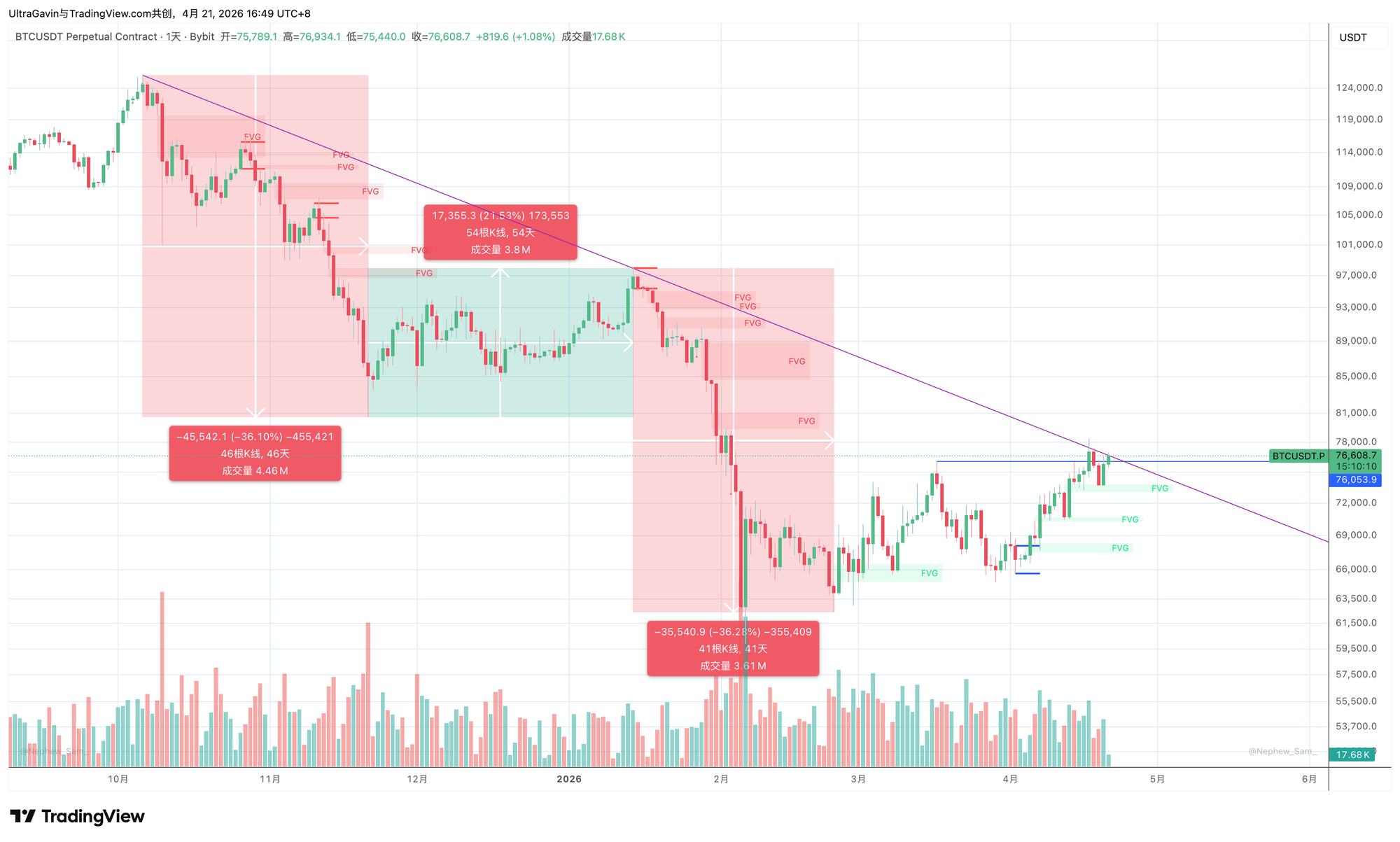
From a daily timeframe perspective, the necessary protocols have been executed, the targeted liquidity has been swept, and the intended longs have been successfully lured in.
II. Why Is the Decline So "Sluggish"?
The issue lies within the smaller timeframes. Shifting to the 4-hour chart, we observe a somewhat unsettling phenomenon:
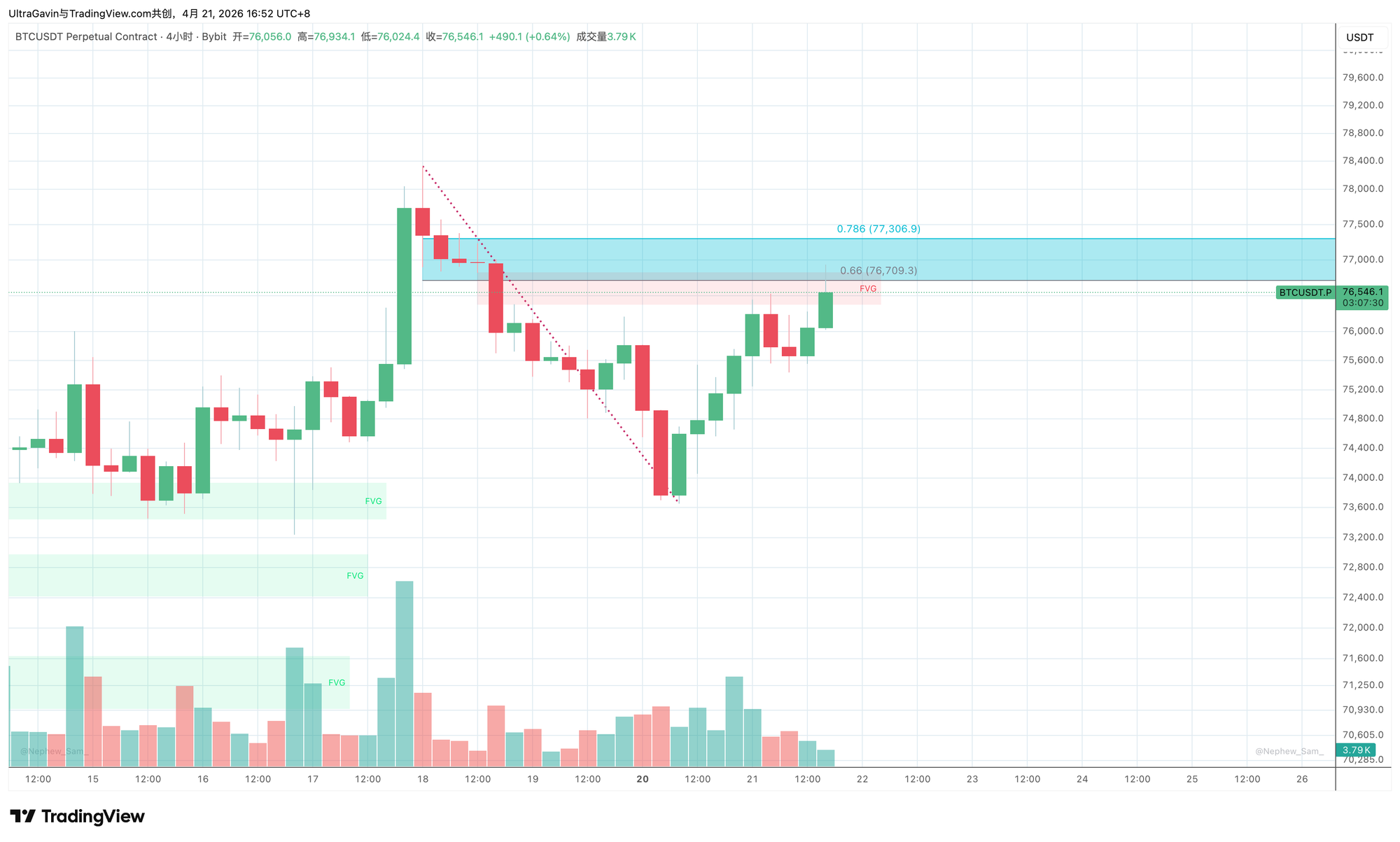
The decline from the April 18 high was relatively orderly; however, the subsequent rebound did not follow the expected weak corrective path. Instead, it aggressively retraced to cover several key levels:
- The Upper Edge of the 4H FVG: The Fair Value Gap formed during the April 18 decline has been completely filled.
- The 0.66 Fibonacci Retracement Level: This level was even briefly breached, with price currently hovering around the $76,500 mark.
The core problem with the current Bitcoin decline is that it feels "too lackluster"—there is no significant volume supporting active institutional offloading. Instead, there is a sense of passive buying pressure "propping up" the price during dips. More importantly, since the fakeout at the April 18 high, almost every mainstream analyst on social media has been calling for the ignition of Wave 5. Short sentiment has reached a state of high consensus.
This represents a contradictory signal that warrants serious consideration.
III. Why Is Consensus Expectation a Risk? — Retail Psychological Structure Before Wave 5
Elliott Wave Theory is widely known, especially among novices and retail traders who hold it in high regard. However, the psychological research behind the theory is something the vast majority of traders overlook; many remain in a state of knowing the "what" without understanding the "why," leading to rote application. Wave 5 differs from the others; it is a wave of emotional catharsis.
In a downward structure, a genuine Wave 5 possesses several counter-intuitive characteristics:
First, before Wave 5 ignites, the market often undergoes a "Secondary Persuasion." The end of Wave 3 is typically accompanied by panic, and the subsequent Wave 4 rally causes a portion of the bears to waver. What institutional capital needs to do is flush out these weak-handed shorts, usually through a small-scale fakeout or an agonizing sideways consolidation in terms of time—both of which have been executed over the past two months.
Second, the momentum of Wave 5 is often weaker than that of Wave 3, yet its lethality remains high. This is due to the difference in the composition of the chips involved in the primary decline: Wave 3 is the combined force of institutional shorting and retail panic selling, whereas Wave 5 is primarily driven by chips that have been transferred to "weak hands" (those who "bought the dip" during Wave 4) cutting losses in panic. In terms of momentum, it acts like a "slow knife," but the cumulative decline often reaches the same magnitude as Wave 1, or even a 1.618 extension in cases of extreme sentiment.
Third, and most critically—a bizarre unanimity of "everyone knows it's going to drop" often appears before Wave 5. Because Wave Theory has a low barrier to entry and is easy to grasp, KOLs and retail traders alike reach a rare consensus that "the collapse is imminent." Paradoxically, this is when institutional capital is most inclined to manufacture a mild bull trap. Since short positions on the tape are currently over-crowded, a small-scale pump toward the $76,700–$77,000 region could trigger a chain reaction of short covering, providing the "Smart Money" with one last surge of abundant counterparty liquidity.
Summarizing the current tape:
- Social Sentiment: Highly consistent bearishness.
- 4-Hour Timeframe: FVG filled, 0.618 touched; the corrective structure is stronger than expected.
- Daily Timeframe: UTAD confirmed, macro trendline pierced, structure complete.
This combination meets the starting conditions for one final bull trap before the official ignition of Wave 5.
IV. Short-Term Noise vs. Daily Timeframe Framework
We must make a clear distinction: the current retracement on the 4-hour chart does not alter any conclusions regarding the daily timeframe framework.
If this 4-hour rebound manages to effectively break above the $76,700–$77,000 zone, we will characterize it as an extended form of the daily UTAD. In this scenario, the topping range is elongated, but the reversal direction remains unchanged. Conversely, if the price is rejected at the current $76,700 level and begins to decline, the primary markdown phase could ignite at any moment.
The common conclusion for both scenarios is: The direction remains the same; only the timing may be delayed by a few days.
For us, we have waited for two months. To waver on a daily-level judgment because of a 4-hour-level retracement, to close short positions at the final moment before Wave 5 officially ignites, and then watch the primary decline begin without us—this would be the classic trading error of "falling just before the dawn."
V. Strategy Execution: Maintaining Rhythm Amidst the Noise
Based on the aforementioned judgment, our tactics remain within the framework of our previous research reports. However, we are issuing two explicit reminders regarding execution:
- Maintain Focus on the $76,700–$77,700 Zone: If the price suddenly surges into this area on high volume over the next few days—even if it briefly holds above $77,000—do not let emotion drive you into impulsive trades. This position corresponds to an extended version of the daily UTAD and is the theoretical price level for the final large-scale institutional offloading.
- Abandon the Obsession with "Will it drop today?": The compounding effect of trading comes from loyalty to logic and execution, not from an obsession with being right in the short term. As of now, the short-side logic on the daily timeframe remains fully valid.
VI. Conclusion
The projections from our previous report have been largely validated on the daily timeframe. The current 4-hour retracement is not a disproof of our bearish thesis, but rather the final psychological test manufactured by dominant players before the ignition of Wave 5. Its technical objective is twofold: to flush out wavering shorts and to lure in a new wave of bulls who believe they are seeing a trend reversal.
At this stage of the trade, the competition is no longer about analytical prowess—it is about who can remain faithful to their original structural chart when everyone else is beginning to falter.
Adhere to the daily framework and ignore intraday noise. This rally’s "final breath" is likely the final door opening into the primary markdown phase.
Disclaimer:
The information and views contained in this research report represent the judgment of the Origin Research analytical team and are considered reliable as of this date, but their accuracy or completeness is not guaranteed. The cryptocurrency market is a high-risk investment field with volatile prices and inherent leverage risks. This report does not constitute direct investment advice, financial advice, or an invitation to trade. Investors should make independent investment decisions based on their own risk tolerance and strictly implement stop-loss strategies.